Futuristic Gaming Screen and Border SVG: A Multi-Format Design Solution for Modern Creatives
The evolution of digital design has brought forth tools that blend aesthetic ambition with practical flexibility. Among these, the Futuristic Gaming Screen and Border SVG bundle stands as a notable example of how visual elements can bridge the gap between digital expression and print functionality. This package, centered around a captivating gradient blue screen and complementary border elements, offers more than just decoration—it provides a structured way to infuse projects with a forward-looking, tech-inspired identity. Whether you are a professional designer, a hobbyist exploring new styles, or an educator looking for engaging visual aids, understanding the capabilities and applications of this bundle can significantly enhance your creative output.
Understanding the Core Components of the Futuristic Gaming Design Bundle
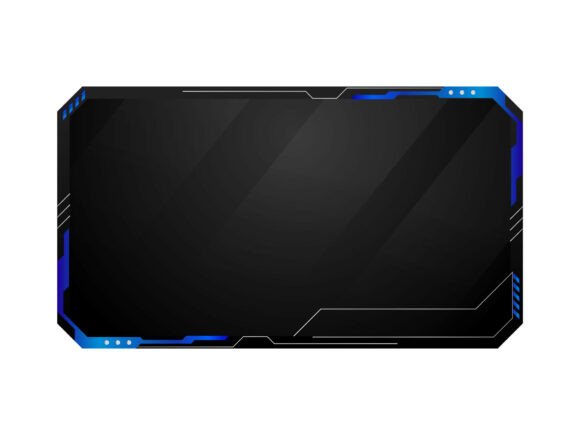
At its foundation, this bundle revolves around a gradient blue screen that evokes a sense of depth, speed, and digital immersion. Blue is frequently associated with technology, trust, and the infinite expanse of virtual space, making it a natural choice for gaming and futuristic themes. The border elements complement this core screen by framing the visual field, adding structure without overwhelming the central design. The combination creates a cohesive look that can be adapted to various contexts, from user interface mockups to printed posters.
The true strength of the Futuristic Gaming Screen and Border SVG lies not only in its visual appeal but also in the range of formats included in the bundle. Access to AI, EPS, PNG, JPG, and SVG files ensures that the design is ready for virtually any workflow. SVG files provide scalability without loss of quality, making them ideal for web interfaces and responsive design. PNG and JPG formats offer immediate usability for presentations, social media graphics, or quick print proofs. Meanwhile, AI and EPS files allow for deep customization in vector editing software, enabling users to adjust colors, shapes, and layering to suit specific project requirements.
The Gradient Blue Screen as a Versatile Visual Anchor
The gradient blue screen serves as the visual anchor of the bundle. Gradients have become a staple in modern design because they introduce movement and dimension to flat surfaces. In this specific case, the blue gradient transitions between shades that suggest both calm depth and electric energy. This duality makes the screen suitable for a wide range of applications: it can act as a subdued backdrop for data visualization, a vibrant frame for gaming streams, or a dynamic base for promotional material.
One observation from using such gradient elements is that they naturally guide the viewer's eye toward the center or focal point of a composition. Designers can leverage this by placing key information, logos, or character art within the gradient area. The border elements then reinforce this focus by creating a defined perimeter that prevents the eye from wandering off the canvas. This interplay between screen and border is particularly effective in gaming contexts, where clarity and visual hierarchy are essential for user engagement.
Practical Applications for Professionals and Creators
The Futuristic Gaming Screen and Border SVG bundle finds relevance across multiple industries and use cases. For graphic designers, the bundle offers a ready-made foundation that can be dropped into larger compositions. Instead of building a futuristic panel from scratch, a designer can import the SVG file, adjust the dimensions, and integrate it into a website mockup, an app interface, or a gaming-themed advertisement. The editable AI and EPS formats allow for fine-tuning of the gradient stops, border thickness, and even the addition of decorative elements like glitch effects or neon accents.
Content creators—particularly those involved in streaming, video production, or social media branding—can use the bundle to establish a consistent visual identity. A YouTube channel focused on gaming reviews, for example, might use the gradient blue screen as an intro backdrop or as a border for gameplay clips. The PNG format is especially convenient for quick overlays in editing software, while the SVG format ensures that the design remains crisp when used in motion graphics or HTML-based web pages.
Use Cases in Education and Research
Educators and researchers may find the bundle useful for creating visually engaging presentations or instructional materials. When teaching concepts related to game design, user interface principles, or digital aesthetics, having a tangible example of futuristic screen design helps students connect theory with practice. The SVG files can be embedded into learning management systems or digital handouts, while the JPG versions can be printed as posters for classroom display. The gradient blue screen also serves as a neutral but engaging background for slide decks, reducing visual fatigue during extended viewing sessions.
For hobbyists and small business owners, the bundle removes the barrier of technical skill. Without needing advanced vector editing knowledge, a user can download a PNG or JPG file and immediately apply it to a flyer, a social media post, or a product label. This ease of access democratizes high-quality design, allowing individuals with limited budgets or time to produce materials that look professionally crafted.
The Multi-Format Advantage: AI, EPS, PNG, JPG, and SVG
The inclusion of multiple file formats is not merely a convenience—it is a strategic design decision that extends the bundle's utility. Each format serves a distinct purpose, and understanding these differences helps users maximize the value of the package.
- SVG (Scalable Vector Graphics): Best for web and digital projects where scalability and interactivity are required. SVG files can be styled with CSS, animated with JavaScript, and embedded directly into HTML documents. They maintain sharpness at any size, making them ideal for responsive designs that need to adapt to different screen resolutions.
- AI (Adobe Illustrator) and EPS (Encapsulated PostScript): These are the go-to formats for professional vector editing. Designers working in Adobe Illustrator, CorelDRAW, or Affinity Designer can open these files, modify individual anchor points, change colors, and combine elements with other vector assets. This level of control is essential for branding projects where exact color matching or custom modifications are required.
- PNG (Portable Network Graphics): With support for transparency, PNG files are perfect for overlays, watermarks, and images that need to be placed on complex backgrounds. The gradient blue screen in PNG format can be layered over photographs or solid colors without a visible white box.
- JPG (Joint Photographic Experts Group): While lossy compression reduces file size, JPG remains a universal format for quick sharing, email attachments, and web galleries. It is the most accessible format for clients or collaborators who may not have specialized software.
By providing all five formats, the Futuristic Gaming Screen and Border SVG bundle ensures that a single purchase covers needs across the entire creative workflow—from initial concept editing in Illustrator to final deployment on a website or printed material.
Integrating the Bundle into Digital and Print Workflows
Adopting new design assets should feel seamless, not disruptive. The bundle's format variety directly supports integration into existing workflows. For a web developer building a landing page for a gaming startup, the SVG file can be directly embedded into the HTML code. The gradient blue screen can serve as a hero section background, with the border elements framing call-to-action buttons or feature highlights. Because SVG is resolution-independent, the design will look identical on a 4K monitor and a mobile screen, provided the scaling is handled correctly via CSS.
Print Production Considerations
When moving from screen to paper, the bundle remains reliable. The AI and EPS files are built at a resolution suitable for print, and the gradient transitions have been designed to reproduce well on coated and uncoated paper stocks. Designers can place the screen and border into a print layout for posters, business cards, or packaging. One observation worth noting is that gradient designs sometimes require careful color management to avoid banding in print. Users working with the EPS or AI files should check that their output settings match the intended print medium. For most standard printing workflows, the provided files offer a good balance between file size and color depth.
For those who prefer printing directly from raster formats, the PNG and JPG files are supplied at a resolution that supports typical print sizes. A user could take a JPG version of the gradient blue screen and use it as a full-page background for an A4 flyer without noticeable pixelation, given the resolution provided in the bundle.
Design Considerations When Using Futuristic Gaming Elements
While the bundle is designed for ease of use, thoughtful application enhances its impact. The gradient blue screen carries a specific tone that may not suit every project. Consider the emotional context of your work: blue tends to evoke calm, authority, and technology, but it can also feel cold if overused. Pairing the screen with warm accent colors—such as orange, yellow, or coral—can create visual contrast and prevent the design from feeling sterile.
The border elements, while decorative, should not distract from the core message. In a gaming interface, borders can define active areas or separate content sections. In a print poster, borders can act as frames that contain the main artwork. One effective approach is to use the border as a mask or clipping path, allowing the gradient screen to extend beyond the borders only in specific areas. This creates a sense of depth and energy that aligns well with futuristic themes.
Another consideration is the balance between screen space and foreground content. The gradient blue screen is visually active on its own, so avoid cluttering the area with excessive text or competing graphical elements. Instead, let the screen breathe. Place essential elements—logos, headlines, or key visuals—in areas where the gradient transitions are smoother, such as the center or lower third of the frame. This leverages the natural flow of the gradient to guide attention.
The Role of Futuristic Gaming Screen and Border SVG in Contemporary Design Trends
Design trends continue to evolve, but certain visual languages remain consistently relevant. The aesthetic embodied by the Futuristic Gaming Screen and Border SVG taps into several enduring themes: cyberpunk, synthwave, sci-fi minimalism, and glitch art. These styles share a common interest in light, color, and geometric structure. By providing a ready-made screen and border set, the bundle allows creators to explore these trends without the overhead of designing complex gradients or repeating vector paths from scratch.
The rise of no-code and low-code tools has also increased demand for plug-and-play design assets. Non-technical users, such as entrepreneurs launching a gaming-themed product or event organizers designing promotional material, benefit from bundles that require zero design software proficiency. The PNG and JPG formats enable them to produce high-quality visuals in minutes. Meanwhile, advanced users retain the freedom to modify the SVG or AI files in alignment with brand guidelines or artistic vision.
Looking ahead, the intersection of gaming culture and mainstream design is likely to deepen. As virtual reality, augmented reality, and metaverse platforms gain traction, visual elements that evoke digital interfaces will become even more valuable. The gradient blue screen, with its nod to HUD (heads-up display) aesthetics and futuristic control panels, is well positioned to serve as a building block for these emerging media. Designers who become familiar with such assets now will have a head start when creating immersive experiences later.
Accessibility and Inclusivity in Design
An often overlooked aspect of using bold visual elements like gradient screens is ensuring accessibility. The contrast between text and background is critical for readability. When placing white or light-colored text on the gradient blue screen, check that the luminance contrast meets WCAG (Web Content Accessibility Guidelines) standards. Tools like contrast checkers can help determine if adjustments to text weight, size, or color are needed. The SVG format is particularly amenable to such adjustments, as CSS can be used to overlay semi-transparent text containers or shadows to improve legibility.
For print applications, consider that certain paper finishes may affect how the gradient appears. Glossy paper can make blues appear deeper, while matte paper may soften the transitions. Ordering a proof before committing to a large print run is a wise practice, especially when the gradient is a central design element.
Final Observations on Implementation
The Futuristic Gaming Screen and Border SVG bundle is more than a collection of files—it is a toolset designed to accelerate creative work across disciplines. Whether used as a background, a frame, or a decorative accent, its gradient blue screen and border elements offer a cohesive visual language that speaks to innovation and digital culture. The inclusion of AI, EPS, PNG, JPG, and SVG formats ensures that the asset can move fluidly between software environments and output media, reducing friction for both novice and expert users.
By understanding the strengths of each format, considering the visual context of your project, and applying thoughtful design principles, you can transform this bundle from a simple resource into a cornerstone of your next project. The fusion of futuristic aesthetics with practical versatility makes it a worthwhile addition to any creative toolkit, whether you are building a game interface, designing a poster, or simply exploring the boundaries of gradient-based design.